
By Kelly Douglas, VP of Client Services – Grants
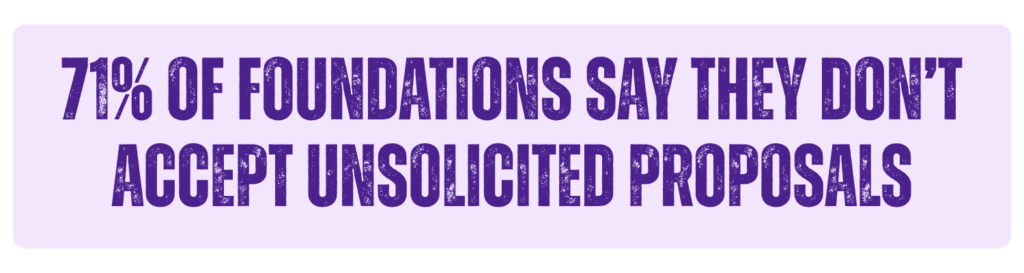
71% of foundations say they don’t accept unsolicited proposals.
For nonprofits, it can feel like standing outside a locked door, but the right strategy can help you open it.
If you’ve ever found the perfect funding match only to see the words “does not accept unsolicited proposals” on a foundation’s website or 990, you’re not alone. According to new IRS data analyzed by Candid, 71% of U.S. private foundations report they don’t accept unsolicited funding requests.
That stat can feel discouraging, especially for small and midsize nonprofits without deep institutional networks. But here’s the good news: “no unsolicited proposals” rarely means no chance at all.
Behind the Data
Candid’s review of more than 112,000 private foundations revealed that about 29% (roughly 33,000) do accept unsolicited proposals. Among larger funders with assets over $100 million, the share is slightly higher at 38%.
Even more interesting: in a separate survey of more than 500 foundations, over half (55%) said they were open to unsolicited proposals. Many foundations still welcome outreach through other channels, including introductory emails, letters of inquiry (LOIs), or conversations that begin at conferences, events, or even on LinkedIn.
The takeaway? These numbers tell us something important: foundations aren’t as closed off as they might appear.
A Shifting Landscape
Over the past year, Alloy has seen more foundations quietly transition to invitation-only funding models. This isn’t because funders have suddenly become less collaborative; it’s because they’re overwhelmed.
As government funding opportunities shrink, nonprofits are turning to private philanthropy in record numbers. The result? Foundations are receiving unprecedented volumes of requests, forcing many to narrow their focus to current or well-established grantees simply to manage demand.
In other words, the doors aren’t closing out of disinterest—they’re closing out of capacity. For nonprofits, that means relationship-building and strategic positioning have never been more essential. And for funders, it’s a reminder that transparency and proactive communication matter now more than ever.
What “Closed” Funders Really Mean
When a foundation says it doesn’t accept unsolicited proposals, it often means they receive more requests than they can review or prefer to fund through networks they already know and trust. Some use intermediaries like community foundations or donor-advised funds to vet and share requests. Finding out how (and whether) to apply can take real time and effort.
For smaller funders, it often involves a mix of 990 research, networking, and good old-fashioned detective work. It would be wonderful if every foundation had a clear, updated website that outlined its priorities, eligibility, and process, but that’s still far from reality.
In practice, many of these same funders still:
1. Allow nonprofits to submit LOIs or introduction forms through their websites (if they have one)
2. Accept referrals from trusted peers or current grantees
3. Invite new organizations to apply after relationship-building or outreach
It takes patience, curiosity, and a little strategic sleuthing.
So How Can Nonprofits Get in the Door?
At Alloy, we see this challenge every day. Here’s how we coach – and collaborate with – nonprofits to navigate it strategically:
💡 Do your research. Start with the basics: read a foundation’s website or 990 to learn who they’ve funded, how much they’ve given, and what their stated purpose is. Make sure your organization is aligned with the foundation’s giving priorities.
🤝 Map out connections. Find out who the foundation’s trustees are and see if you or anyone at your organization has a connection on LinkedIn. A warm introduction goes much further than a cold submission.
✉️ Lead with an LOI. If a foundation’s process isn’t clear, an LOI can be a gentle entry point—a brief, thoughtful note that introduces your mission and impact.
🧭 Track your outreach. Every email, phone call, and touchpoint matters. Keep careful notes so you don’t duplicate efforts or miss a follow-up opportunity.
🔍 Be patient and persistent. Finding the right contact, confirming eligibility, or understanding submission windows can take time, but the relationships you build along the way are often just as valuable.
Changing How We Think About Access
The nonprofit sector often talks about “access to funding” as if it’s a locked gate with a single key. In reality, it’s more like a network of doors— some well-marked, others built one conversation (or one 990 review) at a time.
Foundations want to make smart, strategic investments. Nonprofits want to build relationships that last. Those goals aren’t at odds; they just require time, trust, and thoughtful communication.
When we reframe “no unsolicited proposals” as “relationship-first funding,” the landscape feels a lot less closed off and a lot more human.
Alloy’s Takeaway
Our advice to nonprofits: don’t get discouraged by “no unsolicited proposals.” It’s not the end of the road—it’s a signal to start mapping your path.
Do your research. Learn who a foundation has funded in the past and where your mission aligns. Leverage your board, staff, and community connections to find a way in. And most importantly, start cultivating now before the next funding cycle opens.
Strong relationships take time to build, and thoughtful cultivation today creates opportunities tomorrow. The best funding partnerships are rooted in trust, alignment, and persistence—qualities every nonprofit already has.
Let’s Open Some Doors Together
At Alloy, we don’t just tell organizations to build relationships; we help them do it. As a hands-on, strategic thought partner, we guide nonprofits through the process of identifying funders, nurturing connections, and creating cultivation strategies that lead to sustainable partnerships.
We help organizations move from uncertainty to strategy—finding the right funders, building the right relationships, and creating proposals that resonate.
Reach out to Alloy to learn how we can help your organization unlock new doors and new opportunities.
Source: Candid, October 2025